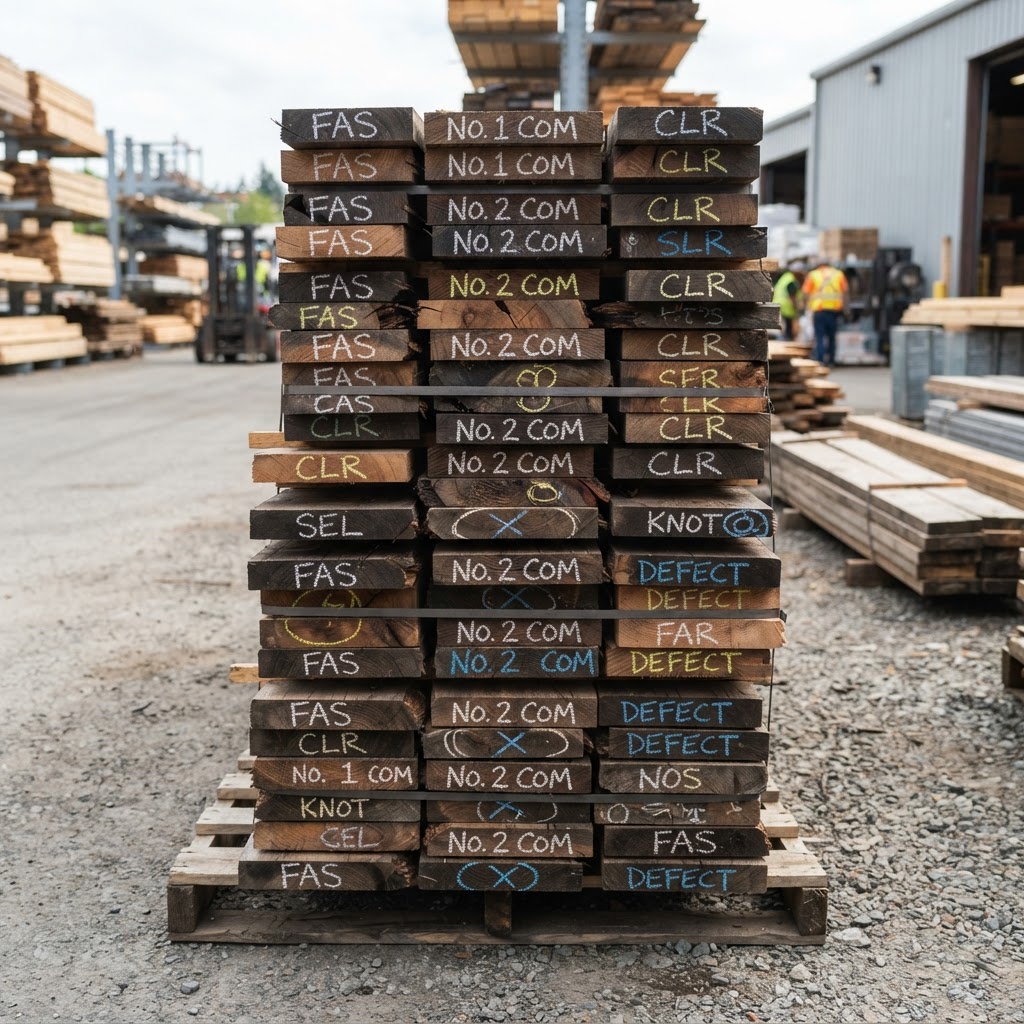
Why Lumber Grades Matter
Hardwood lumber grades determine how much usable (clear) wood you get from a board. Higher grades have fewer knots, defects, and sapwood — but they cost more. Understanding grades lets you match your budget to your project's actual requirements.
The NHLA Grading System
The National Hardwood Lumber Association (NHLA) sets the standard grading rules used across North America. Grades are based on the percentage of a board that yields clear (defect-free) cuttings.
FAS (First and Seconds)
- •Minimum clear yield: 83.3% (10/12ths)
- •Minimum board size: 6" wide × 8' long
- •Best for: Large tabletops, wide panels, show surfaces
- •Cost premium: Highest price
- •Both faces must meet the grade
FAS One Face (F1F)
- •Clear yield: One face meets FAS, other face meets #1 Common
- •Practical advantage: Often only one face shows in furniture
- •Cost: 10-15% less than FAS
- •Great value for cabinetry and furniture
Select
- •Similar to F1F but with smaller minimum board size (4" × 6')
- •Clear yield: One face FAS, other #1 Common
- •Best for: Projects using moderate-width boards
- •Usually sold mixed with FAS One Face
#1 Common
- •Minimum clear yield: 66.7% (8/12ths)
- •Minimum board size: 3" wide × 4' long
- •Best for: Shorter pieces, frame parts, smaller components
- •Cost: 25-40% less than FAS
- •The sweet spot for most woodworking projects
#2 Common
- •Minimum clear yield: 50% (6/12ths)
- •Minimum board size: 3" wide × 4' long
- •Best for: Very short pieces, rustic projects, small turnings
- •Cost: 40-60% less than FAS
- •Significant waste, but excellent for projects using short stock
Grade vs. Value: The Smart Buyer's Math
Here's what most people miss: #1 Common is often the best value.
Example: Building a Dining Table (needs 40 bf of clear stock)
| Grade | Price/bf | Yield | Board Feet Needed | Total Cost |
|---|---|---|---|---|
| FAS | $10 | 85% | 47 bf | $470 |
| #1 Common | $7 | 67% | 60 bf | $420 |
| #2 Common | $5 | 50% | 80 bf | $400 |
The price difference between FAS and #1 Common lumber narrows dramatically when you account for yield. #1 Common generates more offcuts — but if you make small projects too, those "waste" pieces become free material.
Softwood Grading Is Different
Softwood lumber (pine, fir, cedar) uses a completely different grading system:
- •Select: A, B, C, D grades (A is best)
- •Common: #1 through #5 (dimensional lumber)
- •Structural: Based on strength properties
Don't confuse softwood and hardwood grades — they're not equivalent.
Thickness Notation
Hardwood thickness uses the "quarter" system:
- •4/4 = 1 inch rough (surfaces to ~13/16")
- •5/4 = 1¼ inch rough
- •6/4 = 1½ inch rough
- •8/4 = 2 inches rough (surfaces to ~1¾")
- •12/4 = 3 inches rough
- •16/4 = 4 inches rough
Thicker stock costs more per board foot due to longer drying times.
Surfacing Options
- •Rough (RGH): Directly from the sawmill; cheapest; requires a jointer and planer
- •S2S (Surfaced Two Sides): Faces planed; edges still rough
- •S4S (Surfaced Four Sides): Ready to use; most expensive
- •S/L/E (Straight Line Edged): One edge jointed for straight reference
Tips for Buying by Grade
- •Always buy #1 Common first — you can often find FAS-quality boards mixed in
- •Specify "no sap" or "no red" if sapwood color matters to your project
- •Ask about Select & Better (S&Btr) — many yards sell this combined grade at a discount
- •For walnut and cherry, sapwood is a bigger issue than grade — specify heartwood only if needed
- •For painted projects, #2 Common is perfectly fine and saves 50%+
- •For rustic/farmhouse styles, lower grades with character marks are actually preferred