Two Legendary Rosewoods
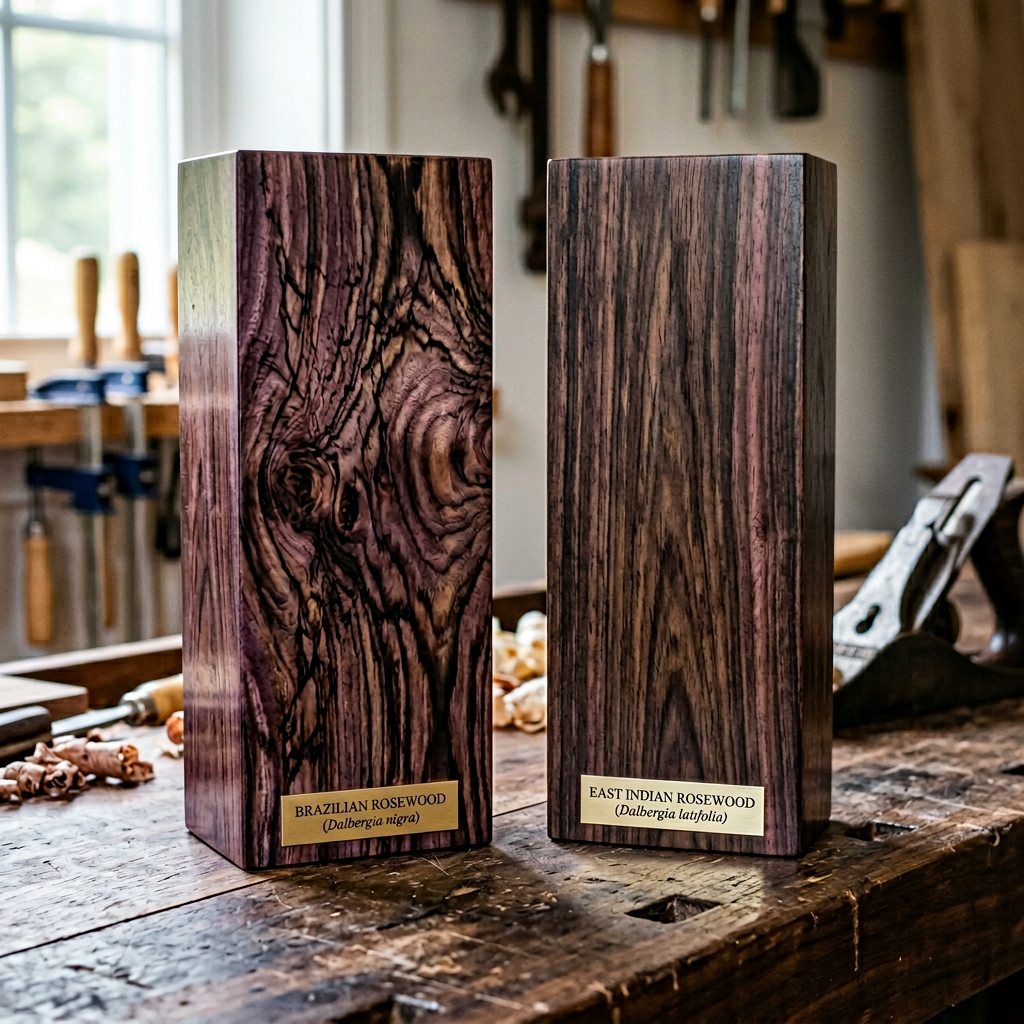
Brazilian Rosewood and East Indian Rosewood are both members of the Dalbergia genus, but they come from different continents, have different properties, and face very different regulatory situations.
Brazilian Rosewood (Dalbergia nigra)
- •CITES Status: Appendix I — commercial international trade effectively banned since 1992
- •Color: Highly variable — chocolate brown, violet, orange, and black streaks
- •Grain: Dramatic, contrasting streaks and spider-web patterns
- •Density: ~52-53 lb/ft³
- •Smell: Strong, sweet, distinctive rosewood fragrance
- •Availability: Virtually unavailable as new lumber. Existing pieces command premium prices.
Brazilian Rosewood is considered the finest rosewood in the world. Its color variation and dramatic figure are unmatched. Pre-ban guitars made with Brazilian Rosewood are worth significantly more than equivalent instruments with other rosewoods.
East Indian Rosewood (Dalbergia latifolia)
- •CITES Status: Appendix II — regulated but available with proper documentation
- •Color: Rose to dark purplish-brown, generally more uniform than Brazilian
- •Grain: Interlocked, sometimes with dark streaks but less dramatic contrast
- •Density: ~52 lb/ft³
- •Smell: Rosewood fragrance, slightly less intense than Brazilian
- •Availability: Available from reputable dealers with CITES documentation
East Indian Rosewood is the primary rosewood available to modern woodworkers. It's an excellent wood in its own right — beautiful, workable, and acoustically superb.
Key Differences
| Feature | Brazilian | East Indian |
|---|---|---|
| Color range | Extremely varied | More uniform |
| Streaking | Bold, dramatic contrasts | Subtler streaks |
| CITES | Appendix I (banned) | Appendix II (regulated) |
| Price | $150+/bf (when available) | $25-60/bf |
| Grain | Often spider-webbed | Interlocked |
| New availability | Essentially none | Available |
Identification Tips
- •Color variation: Brazilian tends to have more dramatic color contrast within a single piece
- •Age and provenance: If the wood is in a guitar or furniture made before 1992, it could be either. Post-1992 instruments almost certainly use East Indian.
- •Fluorescence: Under UV light, some differences may be visible, though this isn't definitive
- •Smell: Brazilian has a stronger, sweeter fragrance
Legal Considerations
If you own an instrument or piece of furniture made with Brazilian Rosewood before the CITES listing, you can generally keep and use it domestically. However, international transport requires documentation, and selling across borders without proper permits can result in severe penalties.
For new projects, East Indian Rosewood is the responsible — and legal — choice.